
University Swag
and Promotional Products
Admissions | Athletics | Alumni
Kit admissions tours, outfit the athletics program, and stock alumni weekend from one approved catalog. Every department orders on its own budget without routing each request through your office. No hidden fees, no stress.

 5.0 · Trusted by over 100+ businesses
Get a free demo
We will build a swag store for your organization. No commitment.
"*" indicates required fields
We reply within one business day. Your details are never shared.
No setup fee
No storage fee
No monthly fee
Free company store
Programs start when you're ready and scale with headcount. Nothing to warehouse, nothing on your books.
Zero inventory hassle
We handle inventory, fulfillment, and logistics while you focus on rewarding your team.
Flexible redemption
Staff spend earned points on premium items, making recognition personal.
HRIS integration
Connects to your HRIS, automating rewards for milestones and achievements.
Dedicated account manager
One point of contact who knows your brand, your budget, and your reorder cadence.
One Campus, a Dozen Buyers, One Brand
Admissions orders for open days. Athletics orders before the season. Advancement orders for reunion weekend. Campus recreation, student affairs, Greek life and most academic departments order too, and very few of them have ever compared notes.
That is why campus merchandise drifts. The same wordmark turns up in three shades of the same color, on garments of wildly different quality, from suppliers nobody centrally vetted.
One approved catalog fixes it. Every department orders what it needs on its own budget, from products your brand or licensing office signed off once. We hold the stock and ship it.
Why CS4 Swag for Colleges & Universities?
What our clients tell us actually made the program work.
Request a demoDepartment-Level Ordering
Admissions, athletics, advancement and campus recreation each order on their own budget from the same approved catalog, without routing requests through one office.No Hidden Fees
No setup fee, no storage fee, no monthly fee. Your store stays open through the summer and across a quiet fiscal year at no cost.Built to Your Brand Standards
We produce to the specification your brand or licensing office sets, and nothing reaches the catalog until they have approved it.Ready Before Move-In
Orientation kits, admissions materials and team gear come out of held stock, so a start-of-term date is not also a production date.What You Put Your Logo On Matters
At CS4 Swag, we go beyond ordinary promotional products. We partner with top-tier suppliers (from eco-conscious brands to trusted industry leaders) to curate premium, stylish swag that reflects your brand’s values. Every project is thoughtfully designed to ensure quality and impact, with no setup or storage fees.
Our white glove service delivers hassle-free, sustainable swag that elevates your brand and resonates with employees and clients alike.
















University Swag, Campus Merchandise, and Alumni Gifts
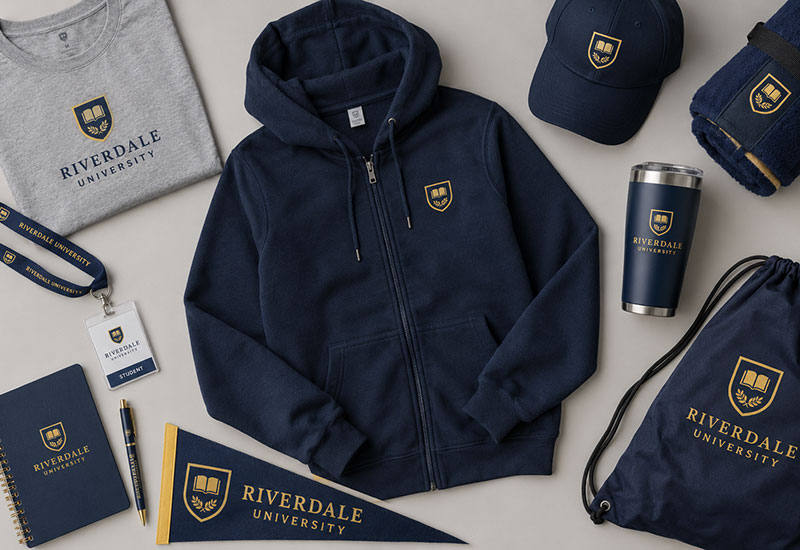
Campus merchandise works best when any department can order what it needs and the result still looks like one institution. Admissions kits, orientation bags, athletics gear, advancement gifts and staff apparel, all drawn from a single catalog your brand office approved once.
Getting there is a coordination problem rather than a purchasing one. A university is not one buyer. It is dozens, spread across admissions, athletics, alumni relations, campus recreation, student affairs, Greek life and every academic department, most of them operating independently and on separate budgets.
This page covers how decentralized campus ordering works in practice, what each stage of the student lifecycle actually needs, how brand standards and trademark licensing fit in, and why the academic calendar shapes the whole program.
Why Campus Merchandise Drifts
No single decision causes it. A department needs shirts for an event, finds a supplier, and gets something acceptable. Another department does the same thing with a different supplier six months later. Neither order is wrong on its own.
Two or three years of that produces a campus where the same institution appears in several logo treatments, several shades of the official color, and a range of garment qualities that runs from genuinely good to visibly cheap. Prospective students notice the cheap end, because a tour is largely a series of impressions.
The fix is not to centralize every purchase, which no university has the staff to do. It is to centralize the catalog and decentralize the ordering.
Ordering Across Departments
Each department gets access to the same approved store, orders against its own budget or index, and ships to its own location. Admissions can pull five hundred folders for a visit day without emailing anyone. A dean can order polos for a faculty event without raising a requisition.
Because everything in the catalog was approved before it appeared there, nothing off-brand can be ordered even by someone who has never read the identity guidelines. That is the part that saves your brand office the most time, and it works without anyone policing purchases after the fact.
Spend stays visible by department, which turns the annual question of what the university spends on merchandise into a report rather than an investigation.
The Student Lifecycle
The useful way to plan a campus program is by stage rather than by department, because the same student is being reached repeatedly by different offices.
Recruitment and campus visits need volume at a sensible unit cost, plus one better item for admitted students. Yield season is where a well-chosen piece does real work: something a committed student wears before they arrive tells everyone at their high school where they are going.
Orientation and move-in is the highest-emotion moment of the year and the one most worth spending on. Lanyards, drawstring bags, water bottles and a good tee show up in photographs that families keep. Current-student touchpoints run through campus rec, student government, residence life and club sports, mostly in smaller quantities and on shorter notice.
Athletics
Athletics behaves like its own institution and usually has its own suppliers, its own licensing arrangements and its own calendar. Game-day giveaways, team travel gear, staff apparel and camp merchandise all sit on different cycles from the academic year.
It is worth deciding early whether athletics sits inside the university program or alongside it. Either works. What causes friction is leaving it undefined, because then two offices believe they own the same relationship and the marks get applied inconsistently across both.
Alumni and Advancement
Alumni merchandise is the one category on campus that can pay for itself. Reunion classes, affinity groups, regional chapters and donor recognition all take merchandise, and alumni are the audience most willing to buy rather than receive.
A store lets chapters and class committees order in their own names without advancement staff processing every request, which is the same problem shape as departmental ordering. For donor gifts specifically, quality matters more than branding. Something a donor will keep on a desk does more for the relationship than something that only announces the institution.
Brand Standards and Trademark Licensing
Most universities protect their marks through a licensing program, and any vendor decorating those marks has to work within it. We build to whatever your brand or licensing office specifies and get artwork approved before production, rather than producing first and asking afterward.
Where your institution requires vendors to hold a license through a specific agency, tell us early. It is a straightforward requirement to work within and a genuinely expensive one to discover late, and we would rather raise it in the first conversation than at proof stage.
Color is the detail that slips most often. Official palettes are usually specified in one color system, and matching them on fabric, on powder-coated metal and in print are three different problems. We match to the standard you give us and flag anything a given process cannot hold.
The Academic Calendar
Higher education runs on a July to June fiscal year, which shapes buying more than most suppliers account for. Spend clusters twice: before year end, when departments use remaining budget, and before the term starts, when orientation and recruitment materials are needed.
Both crunches are predictable, which means both are avoidable. Producing core items once and drawing them down through the year turns the September scramble into a pick from stock. It also means a department finding budget in June can spend it on something already specified rather than starting a sourcing exercise with weeks left in the fiscal year.
What It Costs
You pay for product and decoration. No setup fee, no storage fee, no monthly platform fee, and no minimum order, so a single department testing the program costs the same to serve as a full campus rollout.
That structure suits institutional budgeting, where a recurring platform charge has to be justified to someone every year and a per-order cost does not. It also means the store can sit dormant across the summer without accruing anything.
Getting Started
Tell us which offices buy merchandise today, what your brand or licensing office requires, and where the current program frustrates people. We will propose a starting catalog with real pricing and build a sample store you can show around before anything is produced.
Nothing is committed until the products, the pricing and the artwork are approved. Request a demo and we will put together a proposed campus program for your institution.
Questions we get on this
Still stuck? Contact us.
How do we stop every department buying from a different supplier?
Give them somewhere better to buy. Departments go elsewhere when the official route is slow, not because they want to go off-brand. One approved catalog they can order from directly, on their own budget, removes the reason to look elsewhere and makes off-brand ordering impossible by construction.
Do you work with our licensing office?
Yes, and we would rather hear from them early than late. We produce to whatever your brand or licensing office specifies and get artwork approved before production. If your institution requires vendors to hold a license through a particular agency, tell us at the outset so it is handled before proofs rather than after.
Can you match our official school colors?
We match to the standard you give us rather than eyeballing it, and we tell you where a process cannot hold an exact match. Official palettes are usually specified in one color system, and hitting them on fabric, on powder-coated metal and in print are three genuinely different problems.
Can different schools or colleges have their own catalogs?
Yes. A university can run one store with separate catalogs and budgets for each school, college, campus or athletics department, visible only to the right group. Central staff still see the whole picture.
What belongs in a student orientation kit?
Things students use in their first week and keep afterward: a drawstring bag, a lanyard, a good water bottle and a tee worth wearing. Orientation is the most photographed moment of the year, so it repays spending slightly more on fewer, better pieces.
Do you supply team and athletics gear?
Yes, though athletics often runs its own suppliers, licensing and calendar. Both arrangements work. What causes friction is leaving it undefined, because two offices then believe they own the same relationship and the marks end up applied inconsistently.
Can alumni buy merchandise directly?
Yes. Alumni are the one campus audience that will happily buy rather than receive, so a store can carry a margin the institution keeps. Chapters and reunion committees order in their own names without advancement staff processing each request.
How does the July to June fiscal year affect ordering?
It creates two predictable crunches: year-end budget use and the start-of-term rush. Producing core items once and drawing from held stock through the year removes both, and it means a department finding money in June can spend it on something already specified instead of starting a sourcing exercise.
What is university swag?
University swag is branded merchandise for a campus community, spanning admissions and recruitment materials, orientation kits, athletics and spirit wear, campus recreation gear, faculty and staff apparel, and alumni merchandise. What separates it from ordinary corporate swag is that dozens of independent departments order it while a licensing office is accountable for how the marks appear.
What is the difference between campus store merchandise and department swag?
The campus store sells to students, families and visitors at retail, and its buyer is the store itself. Department swag is bought by admissions, athletics, advancement and academic units for their own use and giveaways. They serve different audiences and rarely share a supplier, though both draw on the same trademarks.
Does CS4 Swag work with K-12 districts as well as universities?
Yes, though the programs look different. A district or independent school usually needs straightforward ordering for spirit wear, staff apparel and events. The multi-department store model earns its keep on a campus with many independent buyers, and we will tell you honestly if a simpler arrangement fits you better.
Start Your Company Swag Store
Start today and make a lasting impact on team morale, retention, and engagement.