

Contents
The restaurant merchandise ideas that sell are simple: a good t-shirt, a hat, and one piece of drinkware, designed so they look like the restaurant rather than an ad, and sold where guests already pay. Square’s Q3 2025 data backs up the order. T-shirts made up 58.2% of food and beverage merch purchases and hats 22.8%.
Most restaurants that try merch don’t fail on demand. Regulars want the shirt. The trouble is everything around it: a box of mediums in the office, no larges, a design that looked better on the screen, and nobody sure who’s supposed to reorder.
So the useful decisions come before the first order.
Restaurant merchandise ideas that sell
Start with the categories guests already buy, then add one thing that’s specific to you.
- T-shirts. The best seller by a distance. Soft, well-fitting, in a full size range.
- Hats. Caps and beanies sell well and don’t need a size run, which makes them easy to stock.
- Drinkware. A pint glass, a mug or an insulated tumbler, ideally something tied to what you serve.
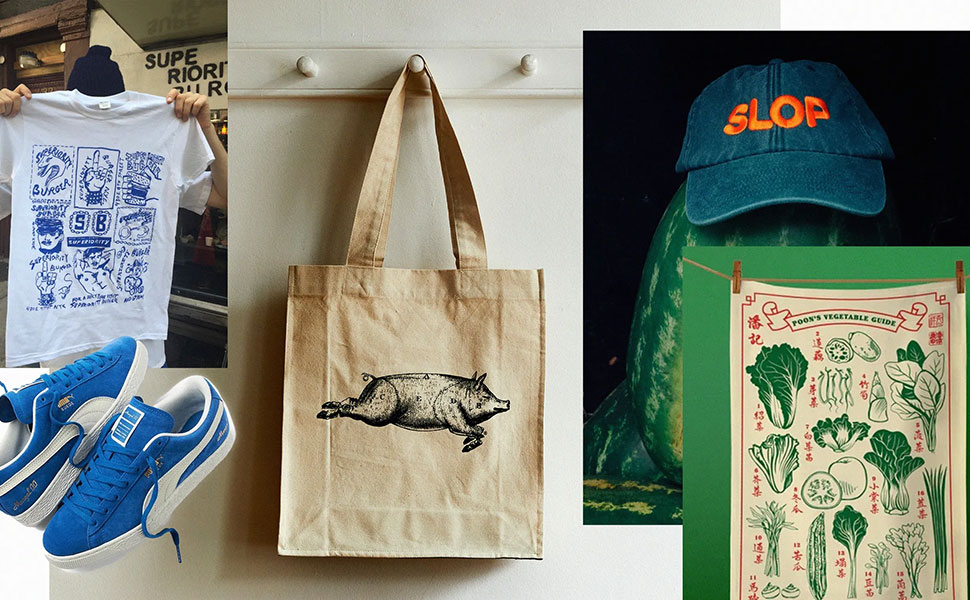
- Tote bags. Inexpensive, carried around town, and good for bundling with a takeaway item.
- A signature piece. An apron like the kitchen wears, a print of your mural, a hot sauce bottle label on a shirt. The thing only you could sell.
Packaged food (your sauce, your spice rub) can sell well too, but it brings labeling and food-safety rules that apparel doesn’t. Treat it as its own project.
The products are the easy part. The harder part is the stock, which is what our merchandise programs for restaurant groups are built around: held off site, ordered in small amounts, and never sitting in a back office.
Start with three products, not twelve
A small range sells better than a big one. Three products give guests an easy choice, keep stock manageable, and let you learn what moves before you spend more.
| Product | Why it’s in the first three | Watch for |
|---|---|---|
| T-shirt | The most purchased merch item; staff can wear it too | Running out of the popular sizes first |
| Hat | One size, easy to stock, high visibility | Cheap blanks that lose shape |
| Drinkware | Ties to what you serve; good gift item | Breakage in storage and shipping |
Add a fourth once the first three are selling steadily. If something sits for a season, drop it and try another. Wineries run the same playbook at the tasting room bar, and these wine club gifts show how member gifts turn into best-sellers.
Design it like the restaurant, not like a promo
The merch that sells is the merch people would wear even if they’d never eaten there. A big logo on a cheap shirt is advertising. Artwork from your menu, a line regulars quote, the street you’re on, or a small mark on a quality garment is something people want.
And quality matters more here than in almost any other swag. A guest is paying for it, and a shirt that shrinks after one wash is a bad review you printed yourself. Choose a better blank and charge for it; regulars will.
Pricing restaurant merch
Price it like retail, not like a giveaway. Guests compare your shirt with what a good shirt costs in a shop, not with what it cost you, so look at what nearby stores charge for something comparable and land in that range.
Merch also tends to carry a better margin than food, which Square’s own food and beverage lead pointed out in the same 2025 data. That margin only shows up if the stock sells, though. Overbuying one design in one color is the fastest way to lose it, which is another reason to start small.
Staff pricing is the exception. A shirt that staff get free or at cost turns your team into the best-dressed ad for it.
Where to sell restaurant merch
Put it where guests already pay, then follow them home.
- At the counter or host stand, visible while people wait
- On the menu or table card, with a QR code to the online store
- In takeout and delivery bags, as a small insert pointing to the store
- Online, year-round, for regulars and people who moved away
- As holiday bundles, paired with a gift card
The online store is the one most restaurants skip, and it’s often where the buying actually happens. A lot of the interest shows up after the visit, when someone’s telling a friend about the place. A branded online store with stock held off site catches that without anyone packing orders in the back office.
Staff merch, perks and uniforms
Staff wearing the merch is the best advertising it gets. But there’s a line between offering it and requiring it.
If you require staff to wear a particular shirt, it’s a uniform. Under the Department of Labor’s Fact Sheet #16, the cost of a required uniform is the employer’s business expense, and charging staff for it can’t bring their pay below the federal minimum wage of $7.25 or cut into overtime. Many states set higher minimums and stricter rules.
The simple version: if it’s required, provide it. If it’s optional, offer it free or at a staff discount, and let people choose. Uniform programs at restaurant groups work best when each location can order a few shirts in the right sizes the week someone starts, which is how we set up uniform programs for restaurant groups. For looks and pieces that hold up on the floor, see our server uniform ideas.
Running merch across several locations
Multi-location groups hit the same problems at scale. One location sells out of larges while another sits on a pile, and every general manager orders a little differently.
One approved range, ordered by each location on its own account, fixes most of it. Stock lives in one place, sizes are held as a spread rather than split up front, and each location reorders small amounts as it sells. There’s no minimum order, so a single location restocking six hats is no different from a group-wide drop, and small on-demand restocks ship from stock already held.
Start small and reorder often
Pick three products, design them like the restaurant, and put them at the counter and online. Reorder what sells. Drop what doesn’t.
That’s a merch program.
If you’d like help with the designs, the stock and an online store for your regulars, request a demo and we’ll put together a starter range for your restaurant.


